
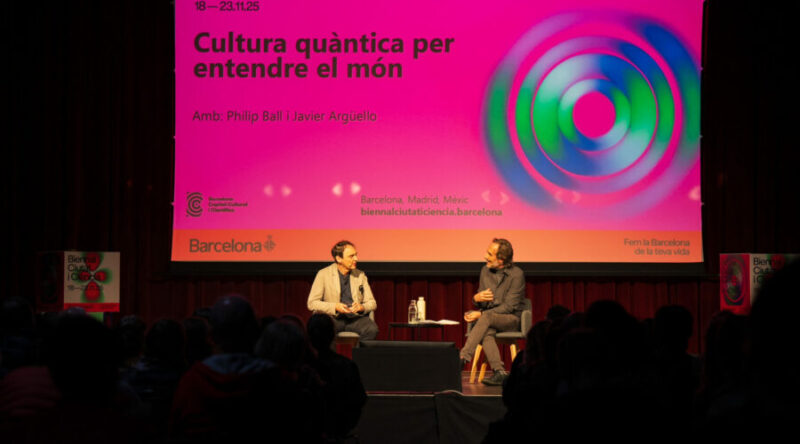
The Biennial City and Science 2025 has proven to be an event of magnitude, reaffirming its presence in both Barcelona and Madrid. With an attendance of 20,000 people, this edition has made it clear that the combination of science and culture can attract crowds and integrate the community into the world of quantum physics.
a quantum phenomenon in Barcelona and Madrid
From November 17, both Barcelona and Madrid were immersed in an experience that takes place between the artistic and the scientific. The Biennial became the epicenter of meaningful dialogues on one of the most complex and fascinating disciplines of our time: quantum physics.
The Terrado Viu of the Museum of Natural Sciences: a long-awaited comeback
In Barcelona, the figure reached 17,500 attendees. There, the conferences and workshops attracted 4,500 registrations, while 13,000 people enjoyed the artistic installations in the Born and the
With the participation of scientific giants such as Juan Ignacio Cirac, José Ignacio Latorre and the brand new Philip Ball, the Biennial not only attracted attention for its activities, but also for the awards given, such as the Nat Award to Ball, presented in the emblematic Greenhouse of the Ciutadella Park.
Among the most striking events was the presence of an avatar of Albert Einstein in Madrid, who engaged in a virtual conversation thanks to the cutting-edge technology developed by the Q-Math group of the ICMAT.
quantum, a bridge between science and society
This year’s Biennial not only sought to attract the attention of science enthusiasts, but, as Jordi Valls, deputy mayor, mentioned, pursued the mission of building a bridge between science and ordinary citizens. In a context where technology no longer answers only to state leaders, but to large corporations, discussions focused on how Europe must strengthen its scientific capacity to protect democratic values and freedoms.
Art installations focused on quantum became a cultural meeting point where science was the central guest. Spaces such as the Born and the sold-out conferences, such as those of Latorre and Cirac, are evidence of the growing interest in these topics. In addition, crossover events, such as the round table on the role of women in science, undoubtedly enriched the community dialogue.
Of course, young people were not left out; the Biennial was proposed as a push to lead them towards future scientists, something that will also be reflected in the upcoming activities in Guadalajara.
sights set on Mexico
The surprise does not end here. In a week’s time, the Biennial will land in
It is commendable how this 2025 edition has capitalized its notoriety not only in its native continent, but now seeks to expand to the other side of the Atlantic. The FIL is a world reference and will serve as a platform to continue encouraging dialogue and reflection on science applied to the great contemporary challenges.
an event of the barcelona strategic plan
The City and Science Biennial is a crucial cog in Barcelona’s 2024-27 Science and Innovation Strategic Plan. Aiming at “knowledge transfer” as the basis for economic and social progress, the city stands out for its pioneering research centers such as the Barcelona Supercomputing Center, the ALBA Synchrotron and the Institute of Photonic Sciences.
There is no doubt that the Biennial represents the commitment of cities to improve public understanding of science and reinforce its role in contemporary society. The event has flourished as an original connection between innovation and culture, providing essential reflections for a more connected and scientifically educated global future.