
The Barcelona City Council’s Government Commission, in collaboration with various institutions, has given the green light to an ambitious project that promises to transform the urban dynamics in the Glòries area. This plan not only envisages the construction of a new concourse at the Glòries metro station, but also a direct connection to the Disseny Hub de Barcelona (DHub). It is a proposal that won the competition organized by the Museu del Disseny and FAD, which will now become a reality thanks to the joint efforts of public and private entities.
A long-awaited transformation
The new Glòries station concourse, designed by the innovative AMOO STUDIO SCP, will not be limited to being a simple access to the metro. This 380 m² space will mark a before and after in the urban panorama of the city, becoming a meeting and transition point between public transport and the cultural sphere. It is not a simple remodeling; it is a comprehensive work with a modern design that will improve accessibility and enhance the connection between the Park neighborhood and the Poblenou Lagoon.
With an estimated budget of just over one million euros, this hall is expected to be ready by the summer of 2026. It will coincide with the world capital of architecture, an event in which the DHub will play a leading role as the venue for the UIA (International Union of Architects) congress.
Integration of space and culture
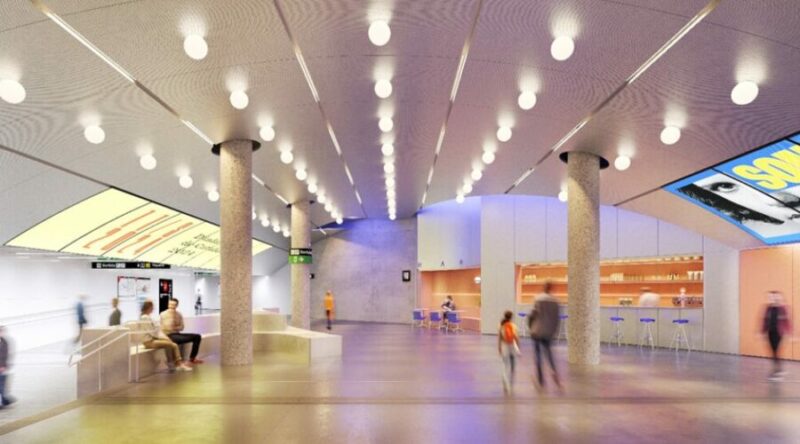
The design of the lobby is impressive by any standards. It has opted for a fluid and accessible configuration, where a suspended ceiling of organic geometry is the protagonist. This ceiling is not only aesthetically attractive, but also integrates lighting, signage, audiovisual screens and technical systems, providing an innovative experience for all visitors.
This space will remain functional. It will include a new bar and a multifunctional bench that will serve as an antechamber to the museum. In addition, an intermediate lobby is planned, which will act as an independent space required by firefighters. It will be clad using the same materials and will be given a special chromatic treatment to maintain the aesthetic coherence of the project.
A step forward in accessibility
The first deputy mayor and president of Transports Metropolitans de Barcelona (TMB), Laia Bonet, emphasized the importance of this project. It not only provides accessibility but also links neighborhoods, something vital for any urban intervention. This idea of connectivity has echoes in other cities: it is similar to the metro connections in London, with the Victoria & Albert Museum, or the Louvre in Paris.
To facilitate the exit from the metro, a new itinerary with a TMB validator area is planned. The suspended ceiling will ensure that the entire space retains formal coherence, improving the user experience.
Comprehensive management for positive impact
The new subway access will operate during the DHub’s regular hours: 9:00 a.m. to 9:00 p.m. daily, except Mondays, when it opens later. Detailed planning is key to anticipate the impact of the new concourse on the DHub’s day-to-day operations. This includes critical issues such as security, cleaning, maintenance and air conditioning.
The works will begin in early 2026 and will be completed in the middle of the same year. Thus, the Barcelona City Council reaffirms its commitment to mobility and accessibility, improving urban quality and boosting the cultural sector, an achievement in which the Department of Territory of the Generalitat de Catalunya and other entities also participate.
In short, the new Glòries concourse is much more than a simple transport improvement. It is a transformative initiative that combines transport, culture and public space in a way that is unprecedented in Barcelona. This project builds the future, connecting people and spaces, and enriching the urban experience.
—