
What is time?
Time has always been a fascinating enigma for mankind. From our earliest moments as a species, we have questioned its nature and how it influences our daily lives. It is an inescapable dimension, so omnipresent that it is easy to overlook, but at the same time so intriguing that it remains a central topic in science.
The invention of time
Reflection on time goes beyond its scientific aspects. It is not only about understanding its physical nature, but also about exploring our perception and how this perception affects our memory and ability to foresee the future. Science offers us endless lessons about time from the beginnings of life to complex phenomena such as black holes. But it also confronts us with profoundly human challenges, such as our identity and how time is intertwined with our experiences.
Time is an essential component of humanity. It shapes us through past memories, but it also propels us forward with the futures we imagine. Every day is a test of how time defines and challenges us.
A journey between disciplines
This journey through the concept of time takes us through different disciplines that, although distinct, share a common fascination for its study. Scientists in all fields have tried, and continue to try, to unravel the mysteries surrounding time. Simultaneously, those in the humanities and the arts do not hesitate to explore its influence on narrative and human identity.
The science of time tells us much about our biological roots, and our internal clocks invariably evolve. However, it is at the intersection of disciplines that we find the most profound and often unexpected answers. Accounts of memory and imagination confirm that time is not just a physical dimension, but an inherent part of our human condition, one in which we constantly renegotiate our relationship to the past, present, and future.
Personal experience of time
Talking about time always leads to thinking about personal experience. For each individual, time goes beyond clocks or theories, becoming a canvas on which each life experience is painted. From childhood memories to expectations of the future, time is a constant in our narrative, influencing how we see ourselves and what we believe is our place in the world.
We live our lives intertwined with time, in a dance in which each step brings us closer to understanding ourselves. Our perception of time depends on our emotions, our moods and our circumstances. Sometimes it seems to fly by in happy moments, while at others, it stretches endlessly during challenges.
Memories themselves are intriguing; they act as fragments of our past that we carry with us, often adjusting and changing with each new reminiscence. The human brain plays an integral role in this perception of time, as it not only stores information but also reinterprets it over time.
Time as a human dimension
Finally, the understanding of time offers us a unique glimpse into what makes us human. It is not only a backdrop to our existence, but a protagonist in our personal journey through life. We find ourselves, time and again, confronting the nature of time in music, literature, art and science. And while we may never fully understand it, its pursuit gives us a direction, a path to self-discovery.
So, regardless of how we interpret it, time remains an integral component of our beings, and perhaps, the magical unknown that we need to respect and explore. In this journey towards understanding it, we discover more about ourselves and what it means to be truly alive.
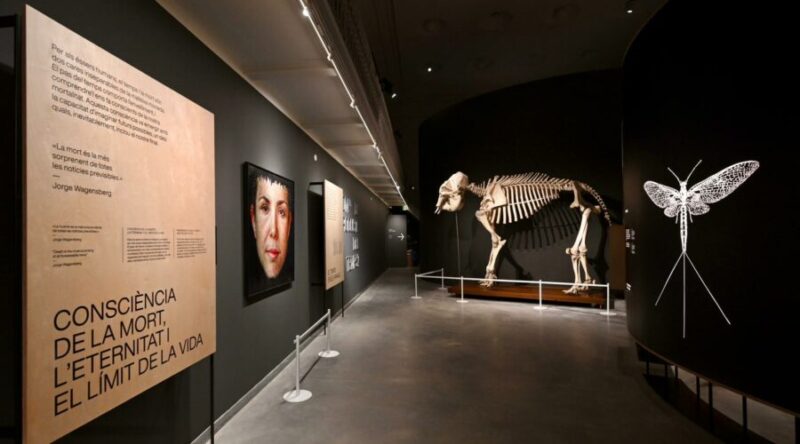
The exhibition interweaves biology, physics, neuroscience, art and literature to explore how time traverses all dimensions of our existence. From the origin of the universe and the evolution of life to the intimate experience of the passage of time, memory, the ability to imagine the future and awareness of the present, the exhibition proposes a journey that connects the cosmic with the human.
It is a unique proposal that is part of the Museum’s Unique Exhibitions program, conceived as an invitation to reflect on Time from multiple perspectives: science, culture, the human condition, philosophy and contemporary thought.
The exhibition is also part of the recovery process of the Martorell Exhibition Center of the Museum of Natural Sciences of Barcelona, located in the heart of the Ciutadella Park. A historic space that recovers its activity as a venue for top-level exhibitions and is integrated into the strategic project of the Ciutadella del Coneixement.
The exhibition is curated by Ricard Solé, physicist and biologist, PhD in Physics from the Polytechnic University of Catalonia. He is currently an ICREA researcher at Pompeu Fabra University, where he directs the Complex Systems Laboratory of the Institute of Evolutionary Biology. He is also an external professor at the Santa Fe Institute in the United States and the Complexity Science Hub in Vienna.